
Oc Character Sheet
An original character (OC) comes alive when you know more than their look: what they want, what they’re afraid of, the little habits that make them recognisable. This character sheet maker walks through the essentials, offers random prompts for traits, goals, flaws and quirks when inspiration stalls, and prints a tidy one-page profile you can keep with your art or story notes.
- Free to use
- No sign-up
- Runs in your browser
OC character sheet maker
Character Design Pack
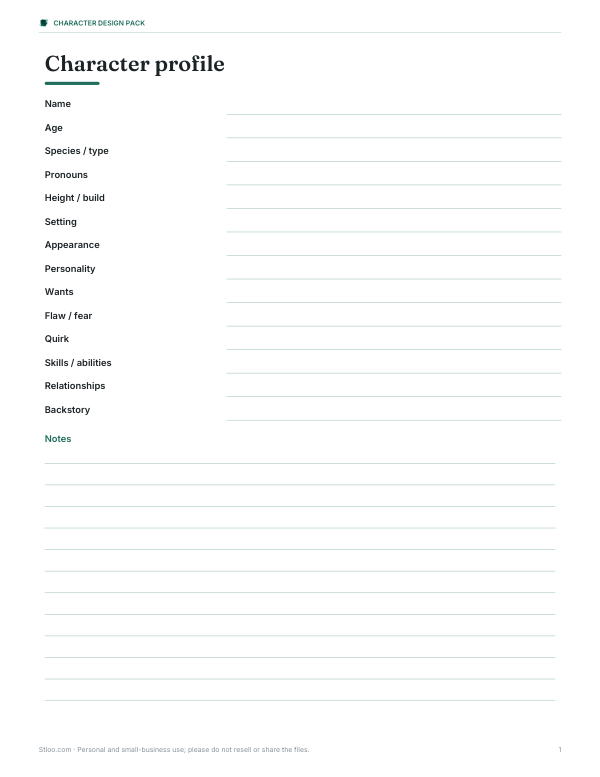
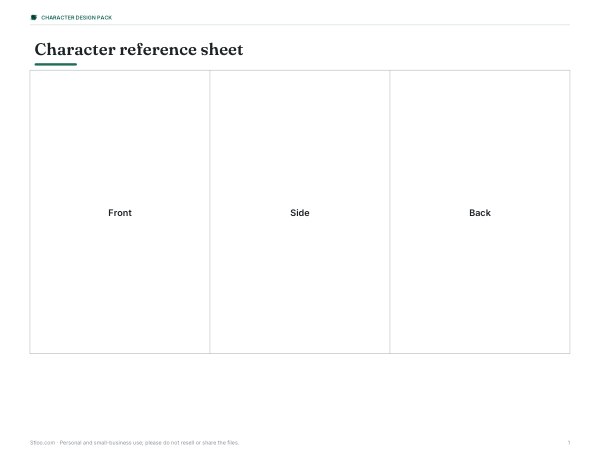
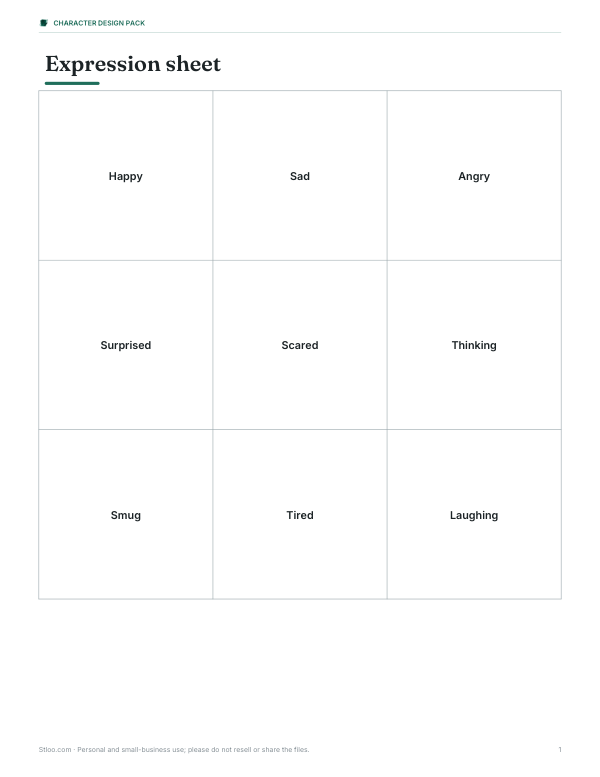
Printable character design sheets: full character profile, reference sheet with front/side/back poses, expression sheet, relationship map and a colour palette card.
- Profile sheet (PDF/DOCX)
- Reference sheet (PDF)
- Expression sheet (PDF)
- Relationship map (PDF/DOCX/XLSX)
- Palette card (PDF)
Formats: PDF, DOCX, XLSX. Instant download after payment (link valid 72 hours, up to 5 downloads). AI-assisted: the templates were drafted with AI help and reviewed and laid out before publishing.
$5.00 USD, one-time 5 files · about $1.00 each
- Instant download
- 7-day refund
- Secure checkout by Stripe
7-day money-back guarantee. Full refund within 7 days of purchase, even after you download.
Free sample: Character Profile Sheet (PDF, 68 KB)
Full refund within 7 days — see the refund policy and license.
Free printables
Single sheets you can print right now, no sign-up. The full pack adds every sheet in one download plus the editable files.
 Printable Character Relationship Map
 Printable Color Palette Card
What goes on a character sheet
| Section | Why it matters |
|---|---|
| Basics (name, age, species, pronouns) | Quick reference for writing and drawing |
| Appearance and colour palette | Keeps art consistent across drawings |
| Personality traits | How they act and react |
| Wants | What drives their choices — the engine of a story |
| Flaws and fears | What holds them back and creates conflict |
| Quirks | Small, memorable details |
| Skills and abilities | What they can do (and limits on it) |
| Relationships | Who they care about and clash with |
| Backstory | How they became who they are |
You don’t need every box filled at the start — many creators add details as they draw and write.
Wants, flaws and conflict
The most useful part of a character profile for storytelling is the tension between what a character wants and what stops them. A cartographer who longs to map the unknown but can’t ask for help will run into trouble the moment the journey needs a team. Pair each want with a flaw or fear, and you have a character who can change over a story — which readers find far more engaging than a character who is simply good at everything.
Building a colour palette
- Choose one main colour that people will associate with the character.
- Add one or two supporting colours for clothes or accessories.
- Include a light and a dark neutral for skin, hair or outlines.
- Keep the same palette across drawings for recognisability.
- Test the palette in greyscale to check the character reads clearly.
The five colour pickers save straight onto the printed sheet, and the hex codes are included in the text download for digital art programs.
Worked example
Wren Hallowell is a 19-year-old cartographer’s apprentice in a floating city. Her palette pairs a copper main colour with slate blue, parchment cream, moss green and ink black. She is endlessly curious with a dry sense of humour, wants to map the unexplored, can’t ask for help, and has a habit of drawing maps on napkins. Her backstory — found as a child in a crate of charts and raised by the city’s map-keeper — explains both her skill and her need to prove herself. Her rival Cass gives her someone to push against.
Using random prompts
The dice button fills personality, goal, flaw, quirk and setting with random prompts from a list of hundreds of combinations. Use it for warm-ups, art challenges or when a character feels flat. Keep what sparks an idea and rewrite the rest — the prompts are starting points, not rules.
Avoiding common pitfalls
- Too many special powers with no limits — give abilities costs or weaknesses.
- Tragic backstory with no effect on present behaviour — show how the past shapes choices.
- Only positive traits — flaws make characters relatable.
- A look that doesn’t match the setting — think about climate, job and culture.
- Being “different from everyone” without specifics — show it through actions and quirks.
Questions to deepen a character
- What do they want, and what do they actually need?
- What would they never do — and what would push them to do it?
- Who do they trust most, and why?
- What is their happiest memory and their biggest regret?
- How do they talk: formal, blunt, rambling, quiet?
- What do other people get wrong about them?
Answering even a few of these in the backstory box gives you material for scenes and dialogue.
Character arcs
| Arc | Shape | Example |
|---|---|---|
| Positive change | Overcomes a flaw or false belief | Wren learns to trust a team |
| Flat arc | Stays true and changes the world around them | A mentor whose values inspire others |
| Negative change | Falls or is corrupted | A hero who becomes the villain |
| Disillusionment | Learns a hard truth | Discovers the map-keeper lied about her past |
Add a line to the backstory about where the character might be by the end — it gives every scene a direction.
Designing for drawing
- Give the character a distinctive silhouette — recognisable as a black shape.
- Choose two or three signature details (a coat, a scar, a hairstyle) and keep them consistent.
- Match clothing to their job, climate and personality.
- Draw a turnaround (front, side, back) so the design stays consistent.
- Record height relative to other characters for group scenes.
Where OCs are used
Original characters appear in comics, novels, animation projects, tabletop and online role-play, fan communities and art challenges. A consistent sheet makes collaboration easier — commissioning art, sharing with co-writers, or keeping a long-running role-play character consistent.
Privacy
Everything you type and any portrait you add stay in your browser; nothing is uploaded.
Frequently asked questions
What is an OC?
An original character — one you created, rather than an existing character from a book, game or show.
What should an OC sheet include?
Basics, appearance, palette, personality, wants, flaws, abilities, relationships and backstory.
How do I make my OC interesting?
Give them a clear want and a flaw or fear that gets in the way.
Can I add a picture?
Yes — upload a portrait and it appears on the printed sheet.
Can I save my sheet?
Print it (or save as PDF from the print dialog) or download the text file.
Is my character uploaded?
No. It stays in your browser.
How many traits should an OC have?
Two or three strong personality traits plus a clear flaw are usually enough to start.
Can I use this for role-play characters?
Yes — the sheet works for tabletop and online role-play as well as art and fiction.